The Anatomy of a Market Signal
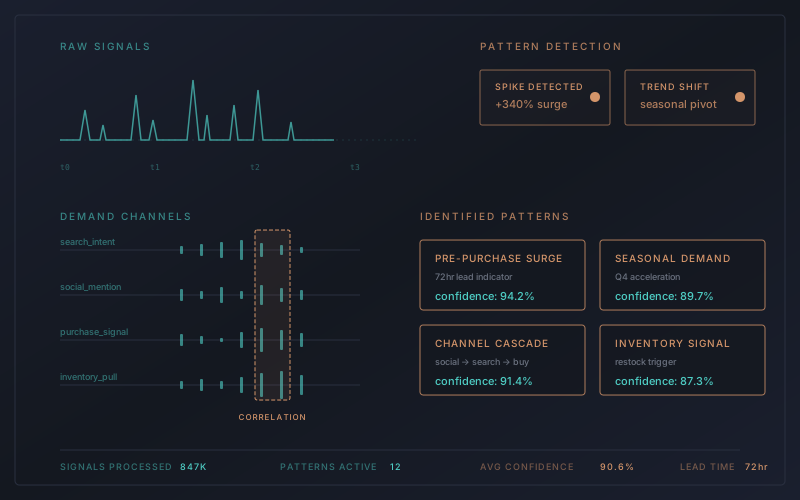
Every interaction at the organizational edge carries a specific "signature." Signal detection is the process of stripping away the chaotic noise of general market activity to find the coherent frequency of a qualified consumer. Unlike traditional lead scoring, signal detection looks at the metadata of the engagement: the velocity of the interaction, the specific sequence of eligibility responses, and the technical point of origin. When these variables align, they form a "detectable pattern" that our systems use to categorize demand before it ever reaches a human operator.
Isolating Intent from Variance
The primary challenge in high-volume markets is the "Noise-to-Signal Ratio." Inregulated environments like legal and insurance, a surge in volume is often mistaken for a surge in opportunity. However, without proper detection, this is frequently just "market variance"—high-volume, low-intent activity that creates an operational tax on internal systems.
- Coherent Signals: Interactions that follow a logical, eligibility-compliant path.
- Incoherent Noise: Fragmented data packets that lack the necessary consent or eligibility markers.
- Stochastic Fluctuations: Random spikes in activity driven by external media cycles rather than genuine intent.
Predictive Modeling vs. Reactive Response
Most organizations wait for the "spike" to occur before they adjust their resources. ADK Insights uses pattern recognition to identify the Pre-Signal Wave. By monitoring the subtle shifts in how consumer clusters are interacting with the boundary, we can predict a volume surge up to 72 hours before it peaks. This allows for:
- Dynamic Throttling: Automatically limiting low-priority signals during high-traffic periods.
- Logic-Gate Hardening: Increasing the complexity of eligibility questions when noise levels rise.
- Endpoint Readiness: Ensuring the internal operations team has the capacity to handle the specific "type" of demand being detected.
The Hierarchy of Pattern Recognition
Our intelligence frameworks look for three specific tiers of market behavior:
- Tier 1: Behavioral Sync: When multiple independent sources start exhibiting the same intent markers simultaneously, indicating a broad market shift.
- Tier 2: Eligibility Clustering: Identifying specific geographic or demographic groups that are currently meeting eligibility criteria at a higher-than-average rate.
- Tier 3: Velocity Anomalies: Rapid changes in the speed of form completions or engagement times that signal a change in the consumer's state of mind or urgency.
Operational Guardrails for Signal Detection
"In an automated system, the cost of a false positive is operational paralysis. We don't just detect patterns; we verify them against historical baselines to ensure they are actionable."
Technical Deployment of Intelligence
Once a pattern is identified, it is converted into a Logic Update. This is the moment the "Intelligence" becomes "Action."
- The Filter Update: The system modifies the entry-point questions in real-time to better capture the specific intent discovered.
- The Routing Shift: Demand is re-routed to specialized internal teams who are best equipped to handle that specific pattern.
- The Volume Buffer: The system creates a temporary holding pattern for signals that show "Partial Intent," preventing them from overwhelming the main intake flow.
READY TO STRUCTURE YOUR MARKET ACCESS?
Partner with ADK Insights to transform market noise into governed operational flow. Whether you are redesigning entry-point logic, solving for inbound congestion, or establishing the next tier of organizational oversight—our frameworks are built to move you from observation to orchestration.

Request a Systems Audit


.png)