I. The Mechanism of Logical Decay
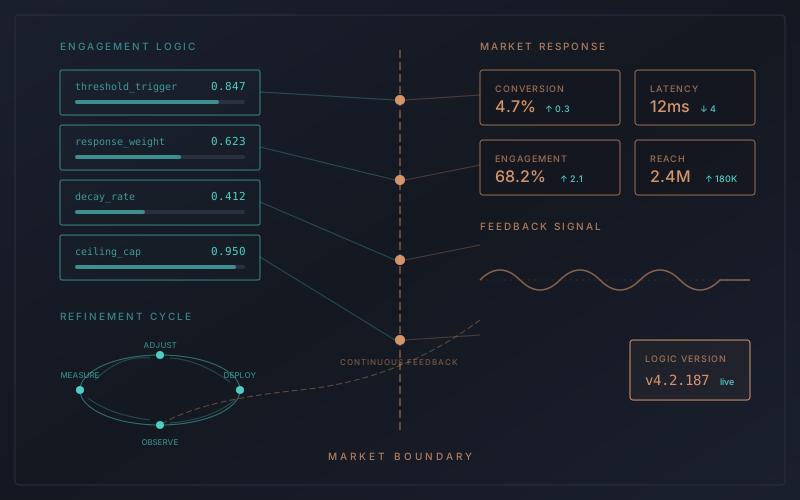
Engagement logic begins to decay the moment it is deployed. Market conditions shift, consumer behavior evolves, and external risk factors fluctuate, rendering initial routing rules less effective over time. Without an active refinement protocol, the market boundary becomes porous—allowing high-noise, low-value demand to leak into internal operations. Ongoing refinement is the corrective force that counters this entropy, ensuring that the "gate" always matches the current market reality.
II. The Closed-Loop Feedback Architecture
The core of our refinement process is the bidirectional flow of information between the market entry point and the operational endpoint. We don't just measure what comes in; we measure what happens after it arrives.
- Downstream Attribution: Tracking the final status of routed signals (e.g., conversion, disqualification, or system rejection).
- Logic Injection: Taking disqualification patterns and immediately updating upstream filters to block similar low-value signals in the future.
- Threshold Balancing: Adjusting the "strictness" of eligibility questions based on the current bandwidth of the internal team.
III. Adaptive Eligibility Scripting
Traditional forms are static; ADK engagement logic is conditional. The refinement process constantly optimizes the "Question Path" a consumer takes.
- High-Friction Gates: When volume exceeds capacity, the logic introduces deeper eligibility layers to prioritize only the most qualified intent.
- Low-Friction Pathways: During low-volume periods, the logic can be tuned to allow broader signals for manual review, ensuring system utilization remains optimal.
- Variable Weighting: Assigning different "importance scores" to specific intent signals based on seasonal or regional priorities.
IV. Stress-Testing Boundary Resilience
To ensure the system remains robust, we periodically execute "Logic Stress Tests." We simulate high-volume noise events to see if the current filters hold up or if they allow system congestion.
- Noise Injection Modeling: Artificially inflating signal counts to find the breaking point of the current routing rules.
- Constraint Discovery: Identifying which internal departments are most vulnerable to "Logic Failures" at the edge.
- Defensive Hardening: Deploying temporary "Emergency Gates" during periods of extreme market volatility.
V. Metrics of Refinement Efficacy
We evaluate the success of our logic updates through a series of clinical performance audits:
- Filter Precision Rate: The ratio of eligible vs. ineligible signals crossing the boundary.
- Manual Intervention Reduction: Tracking how many signals required human triage compared to the previous logic version.
- Edge-to-Operation Latency: Ensuring that increased logical complexity does not slow down the speed of valid demand.
- Boundary Durability: The length of time a logic set remains effective before requiring its next recalibration.
VI. The Role of Governance in Refinement
"Logic without oversight is a liability. Every refinement to the engagement path must be audited for compliance, ensuring that while we optimize for flow, we never sacrifice the consent-aware standards of the organization."
VII. Deployment of Optimized Logic Sets
Once a refinement is validated, it is pushed to the boundary as a "Logic Set." These updates are non-disruptive, occurring in real-time without taking the system offline. This allows the organization to pivot its entire market posture in minutes rather than weeks. The result is a boundary that acts as a dynamic membrane—constantly tightening or expanding to meet the strategic needs of the business.
READY TO STRUCTURE YOUR MARKET ACCESS?
Partner with ADK Insights to transform market noise into governed operational flow. Whether you are redesigning entry-point logic, solving for inbound congestion, or establishing the next tier of organizational oversight—our frameworks are built to move you from observation to orchestration.

Request a Systems Audit


.png)